
Waste management often looks like an infrastructure problem.
But from our experience at BSU Mandiri, we have learned that infrastructure is only one part of the solution.
The bigger challenge is building a system that people understand, trust, and are willing to participate in.
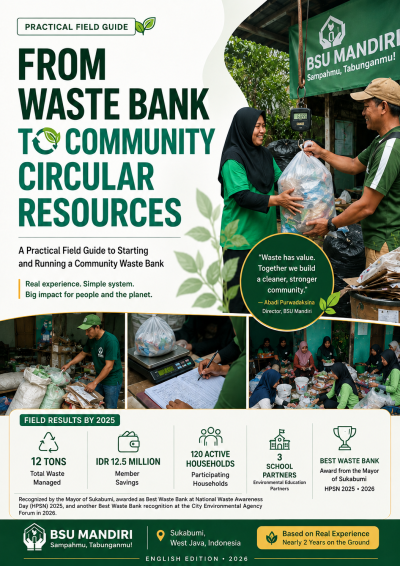
That experience is why we decided to create a free English-language guide:
Community Waste Bank Guide: From Zero to Community-Based Waste Management
Why We Created This Guide
BSU Mandiri started with a simple idea: create a practical community-based system where households can separate recyclable waste, bring it to a community waste bank, and receive economic value from the materials they collect.
The concept sounds simple.
The reality is not always simple.
Building participation requires continuous education. Volunteers need to be organized. Waste needs to be sorted correctly. Transactions need to be recorded. Households need to see a reason to keep participating.
There are also operational challenges that are not always visible from the outside.
Through our experience, we realized that many communities may have the willingness to start but do not know where to begin.
So we decided to document the basic process and lessons we have learned.
What Is a Community Waste Bank?
A community waste bank is a community-based waste management system that encourages households to separate recyclable materials and bring them to a designated collection point.
Instead of treating recyclable waste simply as something to throw away, the system recognizes that some waste still has economic value.
Households can deposit recyclable materials, which are weighed and recorded. The materials can then be aggregated and sold through recycling or waste-management networks.
More importantly, the system creates an opportunity to build a culture of waste separation at the household level.
What We Have Learned from BSU Mandiri
One of our most important lessons is that behavior change cannot happen through infrastructure alone.
A waste bank may have collection equipment, weighing scales, storage space, and a digital recording system.
But without community participation, the system will not work.
Some households understand how to separate their waste immediately.
Others need repeated education.
Some households separate only part of their waste.
Others may still bring mixed materials.
This is normal in the early stages of community-based waste management.
The solution is not simply to blame residents.
The solution is continuous engagement.
Education becomes part of the daily operation.
What the Guide Covers
Our free guide is designed as a practical starting point for communities and organizations interested in developing a community waste bank.
It covers topics such as:
- Understanding the community waste bank concept
- Preparing a community before starting
- Organizing people and responsibilities
- Establishing collection and weighing activities
- Basic waste sorting
- Recording deposits and transactions
- Engaging households
- Developing community participation
- Managing basic operations
- Learning from challenges in the field
- Building the system gradually over time
The guide is not intended to provide a single model that every community must copy.
Every community has different conditions, resources, leadership structures, and waste characteristics.
Instead, we hope it provides a practical foundation that can be adapted to local circumstances.
Who Can Use This Guide?
The guide may be useful for:
- Community leaders
- Environmental communities
- NGOs and civil society organizations
- CSR and ESG teams
- Local governments
- Schools and educational institutions
- Universities and researchers
- Social enterprises
- Environmental practitioners
- Organizations developing circular economy programs
For companies and CSR teams, the guide can also provide context when designing community-based waste management programs.
Rather than starting with infrastructure alone, organizations can consider how community participation, education, operations, and long-term ownership will be developed together.
From Waste Collection to Circular Resources
A community waste bank can be more than a place where recyclable materials are collected.
When developed consistently, it can become part of a broader community circular economy system.
Materials that would otherwise be discarded can be collected, sorted, aggregated, and directed toward appropriate recycling channels.
At the same time, the community gains experience in managing resources more responsibly.
This is the direction we are continuing to explore at BSU Mandiri.
Our long-term goal is not simply to collect more waste.
It is to help build a community system where waste reduction, resource recovery, economic participation, environmental awareness, and community development can work together.
Download the Free Guide
We are making the guide available in English because we want the experience from a community waste bank in Indonesia to be accessible to a wider international audience.
Download the free guide:
👉 Community Waste Bank Guide – Free Download
We hope it can help another community take its first step.
A Guide That Can Grow with the Community
This guide is not meant to be a final answer.
Community-based waste management continues to evolve, and different practitioners have different experiences.
We welcome feedback, practical experiences, and suggestions from organizations and practitioners working in community-based waste management.
Future editions may incorporate relevant insights and lessons learned from the field.
If your organization is working on waste management, circular economy, CSR, ESG, community development, or environmental action, we would be glad to connect and exchange experiences.
Sometimes, meaningful change does not begin with a large facility.
It begins with a community deciding to do something differently.
And sharing what we learn can help another community start.