Start a Community Waste Bank From Zero
A practical guide to building a community-based waste management system, based on the field experience of BSU Mandiri in Sukabumi, Indonesia.
Get the Free Guide Free PDF • English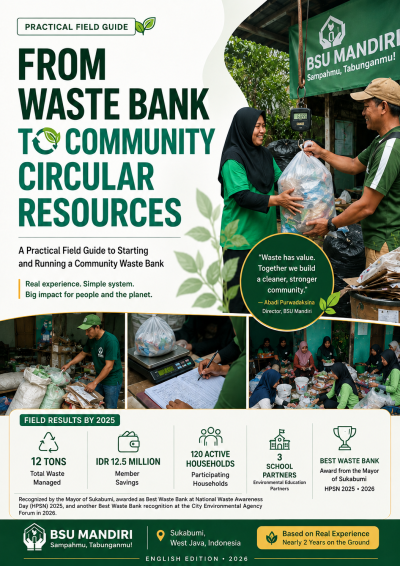
From Waste to Community Action
A waste bank is not simply a place where people bring recyclable materials.
It can become a practical community system that connects environmental action, household participation, education, and local economic value.
Waste should not immediately become something to throw away. It can become a resource when communities have the system to manage it.
This guide explains how BSU Mandiri began turning that idea into practice.
What You Will Learn
Practical lessons from building a community waste bank from the ground up.
Starting From Zero
How to begin a community waste bank with limited resources and a simple operational model.
Building Community Participation
How to introduce waste sorting and encourage households to participate consistently.
Daily Waste Bank Operations
How recyclable materials can be collected, sorted, weighed, recorded, and managed.
Recording & Financial Management
Why accurate records matter and how simple systems can help manage household deposits and transactions.
Community Education
Why waste sorting requires continuous education rather than a one-time campaign.
Growing the Model
How a waste bank can gradually develop into a broader community circular resource system.
Practical knowledge for communities ready to act.
You do not need a large facility or a large budget to begin.
The first step can start with a community, a simple system, and the willingness to keep learning.
BSU Mandiri
BSU Mandiri is a community-based waste bank initiative in Sukabumi, West Java, Indonesia.
The initiative began in 2024 by working directly with households to collect and manage recyclable waste.
Residents bring sorted recyclable materials from their homes. The materials are weighed, recorded, and managed through a community-based system.
The model continues to evolve through daily practice, community education, volunteer involvement, and partnerships.
What We Have Learned
Building a community waste bank is not always easy.
Some households immediately understand waste sorting. Others need repeated education. Some people participate consistently. Others stop and return later.
Operational challenges, limited resources, changing participation, and market conditions are part of the journey.
Community-based environmental work is not built through one campaign. It is built through consistent action.
From Waste Bank to Circular Resource Center
We believe the future of community waste management goes beyond collecting recyclable materials.
Waste Collection
Recovering recyclable materials from households and keeping them within the resource cycle.
Sorting & Material Recovery
Separating materials so that valuable resources can be recovered and reused.
Organic Waste Management
Exploring composting and other biological resource recovery approaches.
Environmental Education
Helping communities understand why waste separation and resource recovery matter.
Community Economic Value
Creating opportunities from materials that were previously treated simply as waste.
Circular Resource Development
Connecting waste management with a wider community resource system.
This is the direction we are continuing to explore through the development of the WasteLoop Circular Resource Center.
Start Where You Are
You do not need to wait until you have a large facility, expensive equipment, or a large team.
Start with what you have. Start with your community. Start with a simple system. Then improve it step by step.
Share the Knowledge
Do you know a community, organization, school, or local government that wants to start a waste bank?
Share this guide with them.
Community-Based Waste Management From Sukabumi
BSU Mandiri is a community-based waste management initiative from Sukabumi, West Java, Indonesia.
We work with communities to reduce recyclable waste going to disposal sites, strengthen household participation, and develop practical approaches to circular resource management.
Our work is grounded in field experience. We learn by doing, measure what we can, share what we learn, and continue improving the system with the community.